





A Comprehensive Analytical Report on Vincent Rags Inc.: Product Architecture and B2B Business Model
Abstract
Founded in 1994 and headquartered in Los Angeles, California, Vincent Rags Inc. is a veteran exporter of used textiles and consumer goods. Its official website—specifically the /products portal—serves as a B2B (Business-to-Business) digital storefront. This report deconstructs the company’s business model, product architecture, supply chain operations, and global market positioning. The analysis reveals that Vincent Rags operates as a critical node in the global circular economy, leveraging rigorous manual sorting (grading) and industrial baling to transform discarded consumer goods into standardized, tradable commodities for developing markets across Africa, Central/South America, and Asia.
1. Corporate Profile and Strategic Positioning
To understand the product catalog, one must first analyze the company’s structural foundations:
Decades of Industry Tenure: Operating since 1994, Vincent Rags boasts over 30 years of supply chain experience. In the secondhand textile industry—where profitability relies heavily on volume, experience, and trust—the company’s longevity serves as its core competitive moat.
The Intersection of ESG and Commerce: The company’s mission bridges environmental sustainability (recycling) with market demand (providing inexpensive alternatives). By diverting surplus goods from Western landfills, they cater to cost-conscious entrepreneurs and consumers in emerging economies.
Pure-Play B2B Model: Vincent Rags does not sell to end-consumers (B2C). Instead, it operates exclusively in bulk. Goods are sorted, compressed, and sold by weight (e.g., 300 lbs bales) or container load to international wholesalers, brokers, and large-scale retailers.
2. Deep Dive into Product Architecture
The /products page outlines a well-segmented product matrix. To optimize shipping costs and match diverse global regional demands, the company categorizes its inventory into seven distinct lines:
2.1 Used Clothing
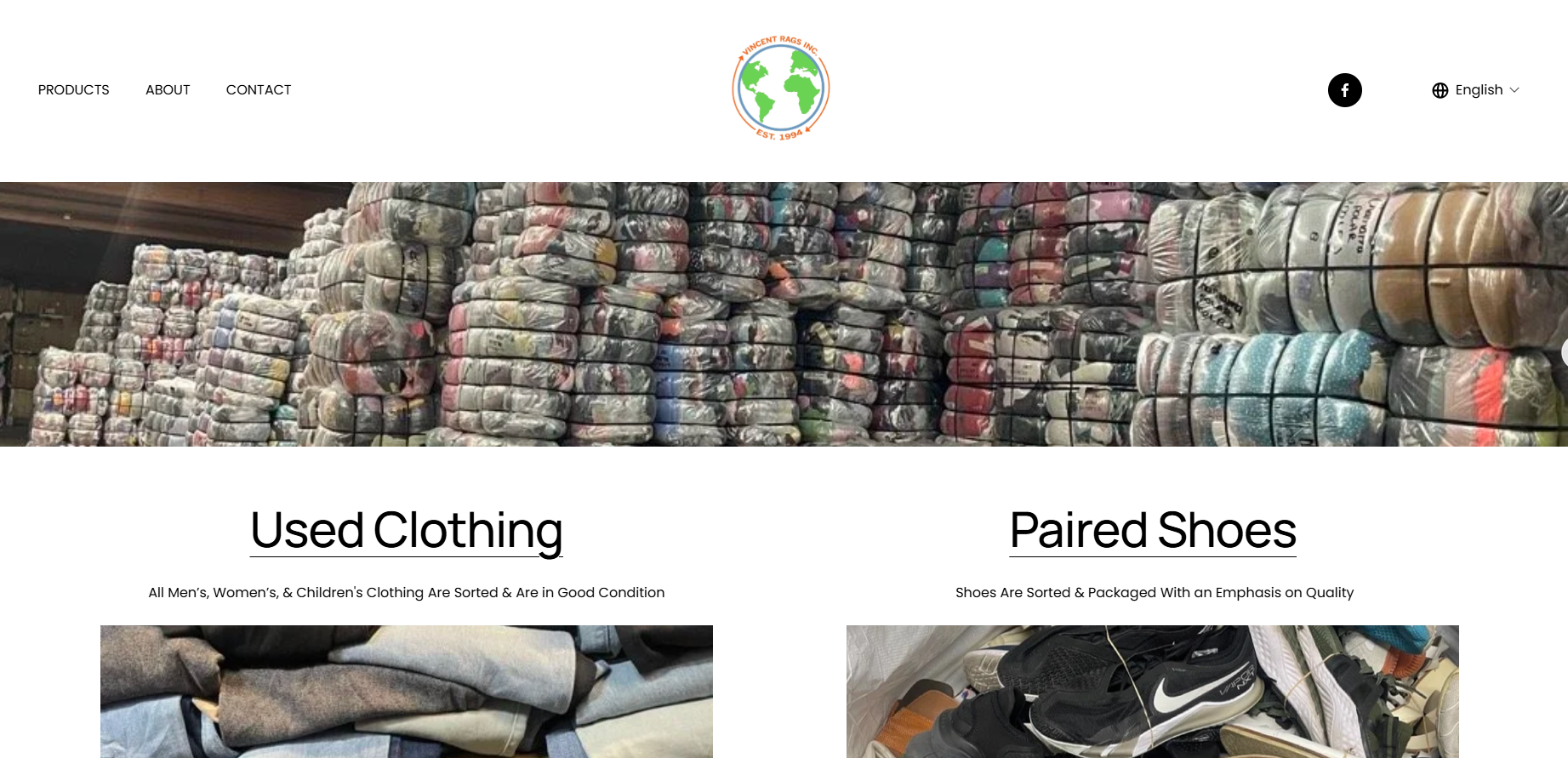
The crown jewel of Vincent Rags’ operations. The website explicitly states that all men’s, women’s, and children’s apparel are sorted and kept in “good wearable condition.”
Operational Execution: The core challenge of used clothing is quality variance. Vincent Rags utilizes a strict grading system to separate garments by wear-and-tear, style, and fabric quality.
Market Alignment: High-grade items (e.g., Grade A) are earmarked for markets with trend-conscious consumers, while utility-grade garments are priced aggressively for regions requiring basic, affordable protection against the elements.
2.2 Paired Shoes
Footwear is a high-margin but operationally intensive category in secondhand logistics.
Pain Point Mitigation: The biggest risk in bulk shoe recycling is unpairing or severe sole damage. By branding this category specifically as “Paired Shoes” and highlighting “quality control,” the company reassures buyers that human pickers have matched every pair and verified structural integrity.
2.3 Soft Toys (Plush Items)
Processing Method: The site notes that these items are “briefly skimmed and baled for distribution.”
Logistical Optimization: Plush toys are highly volumetric but low-density. Compressing them via heavy-duty hydraulic balers into brick-like units minimizes dead space in shipping containers, dropping the per-unit freight cost drastically.
2.4 Hard Toys & Miscellaneous
Quality Standard: The website filters for toys that are “in reusable playing condition.”
Safety Considerations: Sorting hard toys (plastics, metals) involves discarding items with sharp broken edges or missing hazardous small parts, protecting downstream end-users (children).
2.5 Kitchenware
Product Mix: Dominated by pots, pans, and essential cooking utensils.
Economic Value: Western household cookware is frequently replaced due to aesthetic upgrades, despite having long lifespans. Heavy-duty cast iron, stainless steel, and aluminum cookware sourced from the US hold exceptional utility value in flea markets abroad.
2.6 Plasticware
Sorting Metric: Defined as “complete and clean.”
Utility Focus: Cracked plastic containers are worthless. The company’s manual screening ensures that only structurally sound, sealable plastic containers are approved for export.
2.7 Purses, Backpacks, & Belts
Quality Assurance: According to product sub-data, accessories are “lightly graded” with a strict rule to eliminate rotten or peeling items.
Standardized Packaging: To preserve the structure of bags without using rigid, space-wasting boxes, Vincent Rags packs these into specialized 300 lbs bales, optimized for containerized shipping.
3. Supply Chain Mechanics and Core Competencies
Vincent Rags’ operational sustainability relies on three supply chain capabilities hidden behind the simple website text:
Meticulous Manual Sorting: Secondhand processing cannot be fully automated. The company’s true asset is its trained labor force that rapidly executes a “Screen–Classify–Quality Check–Bale” workflow, transforming chaotic raw waste into graded inventory.
Geographic and Cultural Adaptation: Global demand is highly fragmented. Tropical Africa requires lightweight cottons, whereas portions of Eastern Europe or South America demand heavier layers or branded sportswear. Vincent Rags curates specific mix ratios inside containers tailored to the target destination’s climate, religion, and cultural preferences.
High-Density Volumetric Packaging: International shipping rates are calculated per container (20ft/40ft HC). By utilizing industrial hydraulic compactors to compress textiles into fixed-weight bales, Vincent Rags maximizes container weight capacities, directly increasing profitability for the importing buyer.
4. Market Footprint and Global Trade Lanes
The website indicates that Vincent Rags exports to over 15 countries. Their primary trade corridors reflect classic global secondhand routes:
Africa: The world’s largest recipient of secondhand clothing (e.g., the Mitumba markets in East Africa), driven by a massive demand for affordable Western fashion.
Central & South America: A geographically advantageous market for a Los Angeles exporter. Regions like Chile (Iquique Free Trade Zone) act as major Latin American redistribution hubs.
Asia: Emerging markets in Southeast and South Asia, which heavily demand high-quality branded shoes, vintage backpacks, and streetwear.
5. Website Evaluation and Digital Transformation Opportunities
As a traditional B2B trade company, [www.vincentrags.com](https://www.vincentrags.com) functions primarily as a digital business card rather than an e-commerce engine.
Strengths:
Frictionless Navigation: The layout of
/productsis highly scannable, allowing prospective global buyers to instantly understand the company’s product categories within seconds of landing.Direct Assurance of Quality: By directly addressing keywords like “paired,” “clean,” and “wearable,” the site proactively handles the primary objections of skeptical international buyers.
Logistical Transparency: Explicitly stating their Los Angeles location signals strong proximity to the Port of Los Angeles—a major global shipping gateway—implying consistent freight routing.
Weaknesses & Recommendations:
Lack of Interactive B2B Tools: The site is largely static. Since B2B clients care heavily about Minimum Order Quantities (MOQs) and custom mixes, adding a “Request a Quote” form or a “Container Volume Calculator” would drastically increase digital lead generation.
Absence of Rich Media (Proof of Scale): The product pages rely purely on brief text descriptions. In an industry prone to international trade fraud, incorporating videos of the sorting facility, images of packaged bales, or photos of stuffed containers would immediately build cross-border credibility.
Monolingual Interface: Given that their core buyer demographic spans Latin America and Francophone Africa, a strictly English website creates barriers. Implementing Spanish and French language toggles would enhance user experience and broaden their organic search capture.
6. Conclusion
Vincent Rags Inc. represents a highly successful execution of traditional circular economy principles. While its digital storefront is minimalist, it clearly communicates a robust, recession-proof operational framework: the monetization of Western surplus through disciplined quality control and efficient logistics.
数据统计
相关导航